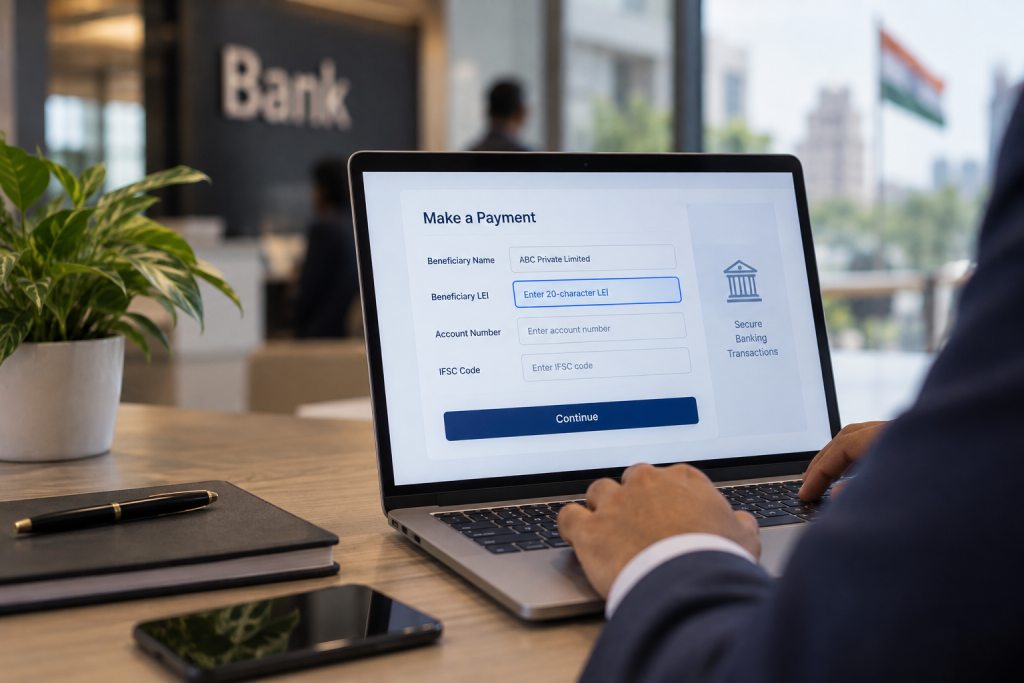
An LEI number for RTGS is the 20-character Legal Entity Identifier that a bank asks for when a large payment goes through the RTGS system. RBI applies the same rule to NEFT. It covers single payments of ₹50 crore and above involving non-individual entities, with exemptions for governments and their departments or ministries. An entity that falls under the rule and holds no code can start LEI registration in India before it submits the payment instruction.
What Is an LEI Number for RTGS?
RTGS does not use a special identifier. The LEI code for RTGS is the entity’s existing LEI, the same 20-character alphanumeric code it uses everywhere else. The LEI identifies the legal entity involved in the payment, rather than its bank account or the payment itself.
The other details on a payment form do different jobs:
- Account number: the account that is debited or credited.
- IFSC: the bank branch that holds the account.
- UTR (Unique Transaction Reference): the individual payment once the bank processes it.
- LEI: the legal entity behind the account.
When Is an LEI Required for RTGS in India?
Non-individual entities generally need an LEI for RTGS payments of ₹50 crore or more. Central and State Governments and their departments or ministries are exempt. The rule comes from RBI circular RBI/2020-21/82, dated 5 January 2021, which took effect on 1 April 2021 for RTGS and NEFT. Two questions decide whether a payment is covered: its value and the parties involved.
The ₹50 Crore Threshold Applies to Each Payment
The threshold is inclusive. A single payment of exactly ₹50 crore is covered, and so is any payment above it. RBI’s wording refers to single payment transactions, so each payment is measured on its own.
Five payments of ₹10 crore each do not trigger this requirement merely because they add up to ₹50 crore. Payment value is also a separate test from borrowing exposure, which RBI measures under different rules for lenders and borrowers.
Non-Individual Payments and Exemptions
Each non-individual party required to provide an LEI supplies its own code. The remitting bank captures sender and beneficiary LEI information where applicable. RBI’s FAQs on large-value payments set out the position in three groups:
- Individuals: no LEI is needed when both remitter and beneficiary are individuals. If only one side is an individual, the non-individual side still needs a code.
- Government departments and ministries: the Central Government, State Governments and their departments or ministries do not have to obtain an LEI or quote one for NEFT and RTGS payments.
- Corporations and undertakings: government corporations and undertakings, including those fully owned by the Government, must obtain an LEI. Their single payments of ₹50 crore and above include LEI information for each party required to provide it.
The Same Requirement Applies to NEFT
NEFT carries the same LEI requirement. The circular covers payments of ₹50 crore and above through both RTGS and NEFT, so an entity uses the LEI it already holds for either channel and needs no second code. Banks put the rule into practice in their own way: HDFC Bank’s guidance applies it to both RTGS and NEFT and asks for the LEI code together with its expiry date.
How to Enter an LEI Number in an RTGS Form
Layouts and field labels vary between banks. This example uses HDFC Bank’s RTGS/NEFT request form, which asks for the remitter’s and beneficiary’s LEI codes and expiry dates.
Worked example (hypothetical): Company A pays Company B ₹75 crore by RTGS. Both are companies, so each must provide its own LEI. On HDFC’s form, Company A enters both codes and their corresponding expiry dates.
Worked example (hypothetical): Company A pays Company B ₹75 crore by RTGS. Both are companies and the amount is above ₹50 crore, so the payment carries both LEI codes and both expiry dates.
1. Enter the Sender’s LEI
Enter the sending entity’s existing LEI in the sender or remitter field. The remitter is the party whose account is debited. Company A is making the payment, so Company A’s LEI goes in this field, entered in full as it appears on Company A’s own LEI record.
2. Enter the Beneficiary’s LEI
Enter the receiving entity’s LEI in the beneficiary field. Company B receives the payment, so Company B’s LEI goes here. The recipient bank’s identifier and the code of an unrelated group company are both wrong entries, because the field names the legal entity that is the beneficiary. If Company B has not shared its code, request it from Company B directly.
3. Complete the Requested LEI Expiry Dates
The LEI expiry date in an RTGS form corresponds to the Next Renewal Date on the entity’s LEI record. This is the date by which the entity must renew its LEI and revalidate its information. The LEI number remains assigned to the entity even if renewal is missed.
HDFC Bank’s form asks for a separate LEI expiry date for the remitter and for the beneficiary, written as DDMMYYYY. If Company A’s record shows a Next Renewal Date of 31 March 2027, the entry is 31032027. If Company B’s shows 15 June 2027, the entry is 15062027. Follow the date format and instructions on the form your bank provides.
4. Check the LEI Details Before Submitting the Payment
Both codes and both dates need to be right before the instruction goes to the bank. Anyone can check an LEI number and its status by searching the complete 20-character LEI or the registered legal name, then opening the record that matches the legal entity. The record shows the registration status and the Next Renewal Date.
Run through this list for each party:
- The full 20-character code is entered without gaps or typos.
- The code belongs to the correct legal entity: Company A’s code for Company A, Company B’s code for Company B.
- The registration status reads ISSUED. A LAPSED status means the renewal date has passed without revalidation.
- The Next Renewal Date on the record matches the expiry date entered on the form.
- The form follows the bank’s own submission instructions, including its date format.
If a code is missing, obtain it from the entity concerned. If the record does not match the details on the form, resolve the mismatch with that entity, and confirm the submission requirements with the remitting bank.
Incoming payments follow a different rule. RBI instructs a beneficiary bank not to reject an incoming transaction because LEI information is missing or inappropriate. After the credit, both banks should hold valid, verified LEI details on file for any payment at or above ₹50 crore. That position gives no assurance about how a particular payment will be processed, so the pre-submission checks still apply.
Obtain or Renew an LEI Through LEI24
The checks point to one of three routes. LEI24 acts as a Registration Agent and facilitates the process. Nasdaq CSD SE, accredited by the Global Legal Entity Identifier Foundation (GLEIF) as a Local Operating Unit (LOU), validates and issues the code.
- No existing code: an entity without an LEI can get an LEI number in India before it submits a payment that falls under the rule.
- Existing record needing renewal or correction: a LAPSED record, or one with outdated details, can be dealt with when you renew your LEI or update it.
- Current record: provide the code and expiry date the bank asks for.
Frequently Asked Questions
Is ₹50 Crore the Minimum Amount for an RTGS Transfer?
RTGS accepts payments from ₹2 lakh upwards. The ₹50 crore figure is a separate LEI threshold: covered payments at or above it must carry remitter and beneficiary LEI details.
Does the LEI Requirement Apply to Online RTGS Payments?
Submitting through online banking does not remove the requirement. Applicability follows the payment value and the parties involved, whether the instruction goes through a branch or a digital channel.
Are RTGS Transfers for Fixed Deposits Exempt From the LEI Requirement?
A fixed-deposit placement or maturity payment routed through RTGS is not automatically exempt. The ₹50 crore single-payment threshold and the party requirements apply as they do to any other payment.