
An LEI is required for certain non-individual borrowers, large-value payments, financial-market transactions and securities issuers in India. Whether your organisation needs one depends on its borrowing exposure, financial activity and the rules applying to the transaction.
An LEI number identifies the legal entity involved. It does not replace a CIN, PAN, GSTIN, bank account number or another Indian registration identifier.
The following flowchart can help you determine whether an LEI requirement may apply to your organisation.
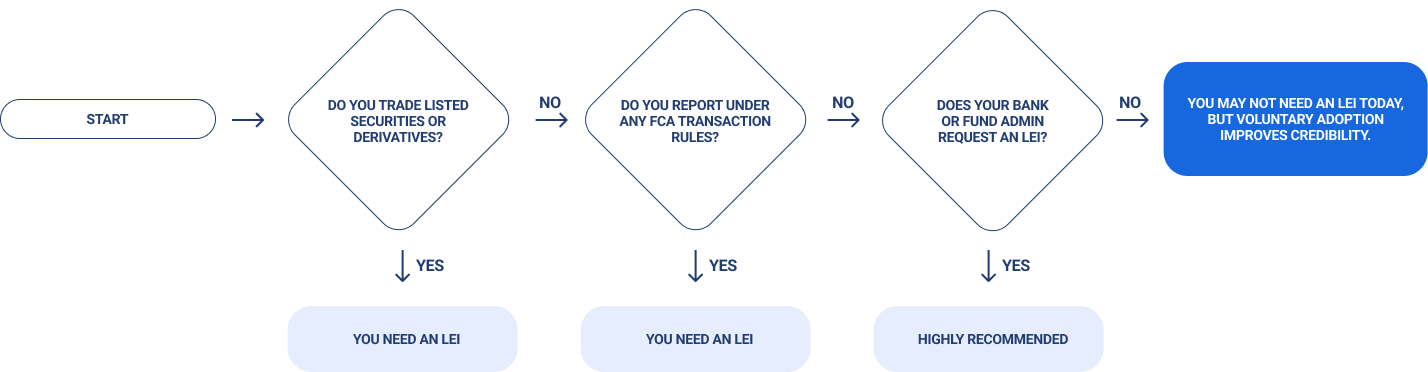
An organisation that does not ordinarily require an LEI may still need one for a particular loan, payment, investment or securities transaction. Your bank, financial institution or regulatory adviser should confirm whether an LEI is required in your circumstances.
LEI registration applicability is determined mainly by the entity’s activity and the relevant regulatory framework. Being incorporated as a company does not automatically mean that every transaction requires an LEI.
| Activity or Circumstance | Who May Need an LEI | Main Requirement |
|---|---|---|
| Borrowing exposure | Non-individual borrowers with aggregate exposure of ₹5 crore or more | RBI borrower framework |
| Large domestic payments | Relevant non-individual parties to a single NEFT or RTGS transaction of ₹50 crore or more | RBI centralised payment system requirement |
| Cross-border transactions | Resident non-individual entities undertaking capital or current account transactions of ₹50 crore or more through an AD Category-I bank | RBI cross-border transaction requirement |
| OTC derivatives | Eligible resident and non-resident market participants other than individuals | RBI financial-market requirements |
| Specified non-derivative markets | Eligible non-individual market participants | RBI financial-market requirements |
| Listed debt and related instruments | Issuers that have listed or propose to list specified securities | SEBI issuer requirement |
The exact LEI requirement can depend on the transaction type, market, entity status and applicable regulator. Thresholds should not be considered in isolation from the rest of the relevant rules.
Under the RBI framework, non-individual borrowers with aggregate exposure of ₹5 crore or more from banks and financial institutions are required to obtain an LEI.
For this purpose, exposure includes fund-based and non-fund-based credit and investment exposure. The aggregate sanctioned limit or outstanding balance, whichever is higher, is used when determining whether the threshold is met.
The framework applies to exposure from specified banks and financial institutions, including covered scheduled commercial banks, local area banks, small finance banks, primary urban co-operative banks, All India Financial Institutions and NBFCs.
Borrowers that fail to obtain an LEI by the applicable deadline may not be sanctioned new exposure or granted renewal or enhancement of existing exposure. This borrower provision exempts departments and agencies of Central and State Governments, but the exemption does not extend to public sector undertakings registered under the Companies Act or corporations established under relevant legislation.
An LEI must also be kept current through annual revalidation. If an existing record has become lapsed, the entity can renew the same LEI number rather than applying for another one. As a Registration Agent, LEI24 can facilitate the transfer process and support future renewals without changing the entity’s 20-character code.
RBI requirements apply LEIs to certain large-value domestic and cross-border payments involving non-individual entities.
Single NEFT and RTGS payment transactions of ₹50 crore or more undertaken by non-individual entities should include the relevant remitter and beneficiary LEI information.
The requirement also applies to covered transactions involving government undertakings and corporations, including those fully owned by the Government. Central and State Governments and their departments or ministries are not required to obtain or provide an LEI for these payment transactions.
An LEI is not required when both the remitter and beneficiary are individuals. Where either or both parties are non-individuals, the relevant LEI requirement applies.
AD Category-I banks must obtain an LEI from resident non-individual entities undertaking capital or current account transactions of ₹50 crore or more. Once obtained, the LEI must be reported for all of the entity’s transactions, regardless of value.
The LEI allows the bank to identify the legal entity involved in the transaction. It does not replace the payment instructions, account details or other information required by the bank.
LEI requirements also apply in parts of the Indian financial markets. The precise requirement depends on the entity, instrument, market and applicable RBI or SEBI framework.
Resident and non-resident participants other than individuals may require an LEI when undertaking covered transactions in:
- Rupee interest-rate derivatives
- Foreign-currency derivatives
- Credit derivatives
Entities that fall within the applicable requirement may be unable to participate in covered OTC derivative transactions without an LEI.
LEI requirements have also been introduced for eligible non-individual participants in specified government securities, money-market and non-derivative foreign-exchange transactions.
Transactions conducted on recognised stock exchanges are outside the scope of the RBI requirement for participation in the specified non-derivative markets. Other regulatory requirements may still apply.
SEBI requires an LEI for issuers that have listed or propose to list covered:
- Non-convertible securities
- Securitised debt instruments
- Security receipts
Issuers should confirm the applicable filing and reporting requirements with the relevant intermediary or adviser.
The same LEI rule does not apply to every organisation. The entity’s legal status and financial activities must be considered together.
A company may need an LEI because of its borrowing exposure, large-value payments, participation in financial markets or issuance of covered securities.
Company registration alone does not create a universal LEI requirement.
Banks and financial institutions use LEIs to identify eligible customers and counterparties in covered transactions and reporting processes. They may also require LEIs for their own regulated activities.
A fund, trust or other legal arrangement may be eligible for an LEI if it can hold rights and obligations independently. Whether it requires one depends on its structure and participation in a covered financial activity.
Additional information or formation documents may be required when the entity cannot be verified through a public registry.
Government undertakings and corporations require LEI information for covered NEFT and RTGS payments of ₹50 crore or more. This is different from Central and State Governments and their departments or ministries, which are not required to obtain an LEI for those payment transactions.
Entity type alone does not determine LEI applicability. The organisation’s legal status, borrowing exposure, financial activity and the rules applying to the transaction must be considered together.
One LEI identifies one legal entity. A parent company’s LEI does not automatically cover its separately incorporated subsidiaries. A subsidiary may need its own identifier if it independently meets an LEI requirement. The same principle applies to other separately constituted entities within a corporate group.
Branches and internal divisions usually use the LEI of the legal entity they belong to. However, an eligible international branch may receive its own LEI under GLEIF rules. Once assigned, an LEI remains connected to that entity. It cannot be reused by another organisation or replaced with a second LEI when the original record becomes lapsed.

If an LEI is required, the application must be completed for the legal entity entering the transaction, holding the borrowing exposure or meeting the reporting obligation.
The LEI registration process verifies the entity’s registered information and, where applicable, its direct and ultimate accounting consolidating parents. Supporting documents may be requested when the information cannot be confirmed through available records.

Register a New LEI:
Apply for an LEI for an eligible entity that does not already have one.
|

Check an LEI Status:
Use an LEI search to confirm whether the entity already has an identifier and whether its record is current.
|

Renew or Update an LEI:
Revalidate an existing record or submit changed entity information.
|

Transfer an LEI:
Move the management of an existing LEI without changing its 20-character code.
|
An LEI is required for certain non-individual borrowers, large-value payments, regulated financial-market transactions and securities issuers. The exact requirement depends on the entity’s activities and the applicable RBI or SEBI framework.
No. Incorporation alone does not create a universal LEI requirement. A company may need one because of its borrowing exposure, payment value, financial-market participation, securities issuance or another applicable requirement.
Non-individual borrowers with aggregate exposure of ₹5 crore or more from covered banks and financial institutions are required to obtain an LEI under the applicable RBI framework.
Relevant LEI information is required for single NEFT or RTGS transactions of ₹50 crore or more involving non-individual entities. Transactions where both parties are individuals do not require an LEI.
AD Category-I banks must obtain an LEI from resident non-individual entities undertaking capital or current account transactions of ₹50 crore or more. Once obtained, the LEI must be reported for all of the entity’s transactions, regardless of value.
Natural persons acting in a personal capacity generally do not need an LEI. The requirement applies to eligible legal entities and legal arrangements rather than individual customers conducting personal transactions.
A separately incorporated subsidiary may need its own LEI if it independently meets an applicable requirement. The parent company’s identifier does not automatically cover other legal entities in the group.
Yes. A bank may require an LEI when processing a covered loan, payment, market transaction or reporting obligation. The business should confirm which requirement applies to its circumstances.
The consequence depends on the applicable requirement. A covered borrower may be unable to obtain new exposure or renewal or enhancement of existing exposure. Other transactions may be delayed or unavailable where an LEI is mandatory.
Yes. LEI reference data must be revalidated annually. If renewal is missed, the record becomes lapsed, although the same LEI remains assigned to the entity.