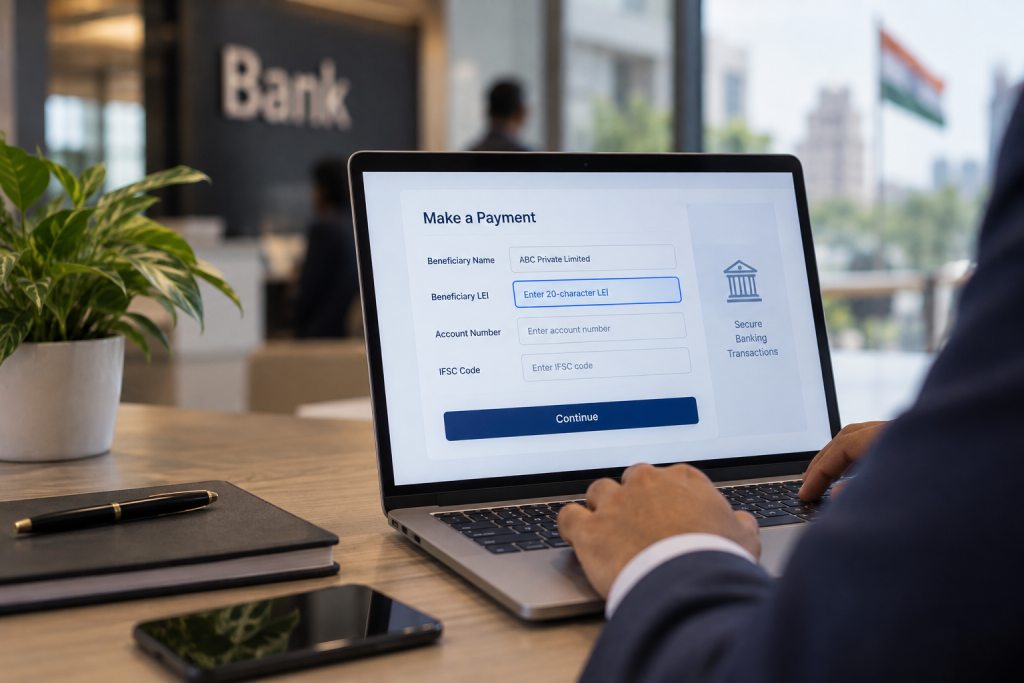
A beneficiary LEI number is the Legal Entity Identifier of the entity receiving a payment. When a banking form asks for it, the field expects the recipient’s existing code, not a new identifier created for the transaction.
In India, RBI requires LEI information for non-individual parties to single NEFT or RTGS payments of ₹50 crore or more. Separate rules apply to cross-border transactions, and exemptions depend on the parties involved. Our team at LEI24 helps entities register, check or renew an LEI for payments.
What Is a Beneficiary LEI Number?
LEI stands for Legal Entity Identifier, a code of 20 alphanumeric characters. “Beneficiary” describes the role the entity plays in one payment: it is the recipient. The beneficiary LEI code is the entity’s ordinary LEI, entered in the field reserved for the receiving side. The role creates no separate identifier, and receiving funds does not require an additional code. Whatever the role, what an LEI number identifies stays the same: one legal entity and its public record.
Beneficiary LEI vs Remitter LEI
The beneficiary LEI identifies the entity on the receiving side. The remitter LEI identifies the entity on the sending side. RBI’s directions on large-value payments use these two terms for the paired LEI details in RTGS and NEFT payments.
One organisation can be the remitter in one transaction and the beneficiary in another, using the same existing code each time.
Whose Code to Enter on a Banking Form
The beneficiary field takes the LEI of the entity that will receive the funds. It does not take the LEI of the recipient’s bank, the sender’s LEI or the code of another company in the same group. A subsidiary receiving the payment is the beneficiary, so its own LEI goes in, not its parent’s.
The four details that sit side by side on a large-value payment form identify four different things:
| Field | What it identifies | Belongs to |
| Beneficiary LEI | The entity receiving the payment | A legal entity |
| Remitter LEI | The entity sending the payment | A legal entity |
| Account number | The account being credited or debited | A bank account |
| IFSC | The branch handling the transfer | A bank branch |
PAN, CIN and GSTIN cannot stand in for an LEI. Each belongs to a different register: tax, company incorporation and GST. None of them is the 20-character code a payment field asks for.
An LEI record also says nothing about who holds a given bank account. It identifies the entity, while the account number and IFSC tie the payment to the account.
When Is a Beneficiary LEI Number Required in India?
The answer depends on the payment channel, the amount and the type of party on each side. An LEI field appearing on a form does not mean every customer must obtain a code.
Domestic NEFT and RTGS Payments
Under RBI’s large-value payment circular, covered single payments of ₹50 crore and above through RTGS or NEFT require the LEI of each non-individual party, whether sender or beneficiary. The directions took effect on 1 April 2021.
The test is the value of one payment, not a monthly or annual total. The threshold also stands apart from the ₹5 crore borrowing requirement, which looks at a borrower’s aggregate exposure rather than at any single payment. Meeting one says nothing about the other.
Payments Involving Individuals and Government Bodies
RBI’s large-value payment FAQs exempt payments where both the remitter and the beneficiary are individuals. Where either side is a non-individual entity, the framework applies once the payment reaches the threshold. The code in question belongs to that entity. An individual acting personally is not asked to obtain one.
Central and State Governments, and their departments and ministries, do not need an LEI for NEFT and RTGS payments. Corporations and undertakings do, including those fully owned by a government, so a state-owned company counts as a covered entity.
The requirement also covers inter-bank RTGS payments that meet the threshold. The remitting bank should capture the sender’s and beneficiary’s LEI information where applicable. A beneficiary bank should not reject an incoming payment solely because LEI information is missing or inappropriate. After crediting the payment, both banks should maintain valid, verified LEI information for transactions of ₹50 crore and above.
Cross-Border Payments
Cross-border payments follow a separate framework. Under RBI’s cross-border LEI circular, resident non-individual entities undertaking capital or current account transactions of ₹50 crore and above, per transaction, under FEMA 1999 must provide an LEI to their authorised dealer bank. The requirement applies from 1 October 2022.
Once an entity has obtained an LEI, it must report that code in transactions covered by this framework, irrespective of transaction size. Where an overseas counterparty has no LEI available, the circular allows banks to process the transaction to avoid disruption.
How to Find and Check a Beneficiary LEI Number
Start with the recipient. Obtain its code, match it to the right entity, then review its registration status before the code goes into a payment instruction.
Request the Code or Search by Legal Name
The most reliable route is to ask the recipient for its LEI. If you only have the name, search for the beneficiary’s LEI in four steps:
- Enter the full registered legal name, not a trading name or abbreviation.
- Set the country filter to the recipient’s country of registration.
- Compare name, address and registration details across the results to find the right entity.
- Open the record and note the 20-character code.
If nothing appears, check the spelling of the legal name and the country, then ask the recipient to confirm its code. An empty result does not by itself mean that no LEI exists.
Verify the Entity, Status and Renewal Date
Three separate questions need answers before a code is used: whether it is complete and correctly formed, whether it belongs to the right entity, and whether its registration is current. A code can pass the first test and fail the others.
| Detail | What to confirm |
| Complete code | All 20 characters are present, none dropped or transposed |
| Legal name | Exact match with the recipient’s registered name |
| Registration details | Registration authority and number agree with the recipient’s own records |
| Address | Registered address fits the entity you intend to pay |
| Registration status | Issued, lapsed or another status |
| Next renewal date | Still in the future, or already passed |
GLEIF publishes every record in the Global LEI Index, and its definitions govern the status labels. ISSUED means the record is current. LAPSED means the renewal date has passed without annual revalidation, while the code stays assigned and searchable. Other statuses cover records that are transferred, merged or retired.
LEI registration status describes the record, not the business. An ISSUED record does not show that an organisation is trading or solvent, and a LAPSED record does not mean it has closed. It means the entity’s data was not revalidated by the renewal date.
Preparing Your Entity’s LEI for Incoming Payments
When a sender asks for your code, first confirm that the request applies to your entity, then look for an existing record under your registered legal name. An entity should hold only one LEI, so any existing record is the starting point for what follows.
The Recipient Does Not Have an LEI
If a code is required and no record exists, the recipient entity or its authorised representative should arrange registration. Once the LEI is issued, the sender needs the resulting code, and the bank can confirm what else it requires with it. Registration runs through an accredited issuer or a Registration Agent, which is the route for how to obtain an LEI number in India.
The Existing LEI Is Lapsed or Incorrect
A lapsed LEI stays assigned to the entity. It needs renewing, not replacing, because an entity should hold only one code. If the record shows an old name, an outdated address or other wrong reference data, the entity should correct it through an update. The code itself does not change. The entity can renew or update an existing LEI whenever the record no longer matches its details.
A lapsed or inaccurate record can raise questions with a bank, so settle it before a payment is due. Check the renewal date and reference data against the entity’s current details, then act on whatever differs. LEI24 is a Registration Agent working through Nasdaq CSD SE, the issuing Local Operating Unit (LOU), and supports entities with renewing or updating their existing records.
Frequently Asked Questions
Can the Same Beneficiary LEI Be Used for Different Bank Accounts?
One LEI identifies the recipient entity across all of its bank accounts. The account number and IFSC code still have to point to the specific account receiving the payment.
Is It Free to Find a Beneficiary LEI Number?
Public LEI records can be searched free of charge. That covers looking up an existing code only: registering a new LEI or renewing an existing one carries a fee.
Does the Beneficiary Need to Provide an LEI Certificate?
Supporting-document requirements depend on the bank. The recipient should ask which evidence is needed; a certificate does not replace checking the current public record.